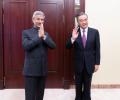
External affairs minister S Jaishankar has told his Chinese counterpart Wang Yi that the two sides should work for an early resolution of the remaining issues along the LAC in eastern Ladakh to restore peace and tranquility in the border areas as this has been an essential basis for progress in Sino-India ties.

Pakistan has quietly banned Tehreek-e-Azaadi Jammu and Kashmir, a new front for Hafiz Saeed's Jamaat-ud-Dawa, as international pressure on the country grew, including from a global watchdog, to combat terror and its funding.

If one concentrates solely on areas of concern, one will develop an unduly pessimistic attitude. If one looks only at the galloping trade and proliferating exchanges of visits, there could be unwarranted over-optimism. There is a need for a balanced perspective.

Unless the Taliban goofs up in a big way, which seems highly unlikely, we are looking at a regime that will be around for quite a long while and present a level of governance that the puppets of the richest and most advanced countries failed to provide, predicts Ambassador M K Bhadrakumar.

The flawed Indian policy toward Afghanistan is missing the woods for the trees. The Modi government doesn't have a 'big picture', observes Ambassador M K Bhadrakumar, who played a stellar role in beginning India's systemic dealings in Afghanistan in 1994.

All the three issues raised by China at the Modi-Xi meeting are either intractable or peripheral to the bilateral relations and suggest conventional methods to placate the other side without yielding much, says Srikanth Kondapalli.

Putin said India will become a full-fledged member of the SCO in a week.

On the last leg of his eight-day six-nation tour, Prime Minister Narendra Modi on Monday made a strong pitch for taking India's ties with Tajikistan to newer heights in diverse areas.
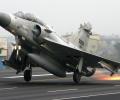
"The Indian government approached asking us to open the airspace. We conveyed our concerns that first India must withdraw its fighter planes placed forward," Nusrat told the committee.
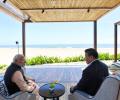
'India's relationship with China has been and will continue to be complex, delicate and sensitive,' says Rup Narayan Das.

The exercise 'Hand-in-Hand' between the armies of the two countries will take place within next 4-5 months in China.
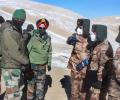
"The meeting thus did not result in resolution of the remaining areas," the Army said in a statement.

Shringla said that diplomacy is looking at a very changed scenario in terms of how statecraft and relations between countries work in the wake of the pandemic.
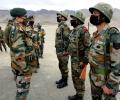
The seventh round of military talks between India and China held on Monday was "positive and constructive", and both sides agreed to earnestly implement the understanding reached by their leaders to not turn differences into disputes, a joint statement by the two armies said on Tuesday.

'While economic ties are making incremental progress, it is in the security and strategic domains that the India-Japan synergy is more compelling,' says Dr Rajaram Panda.
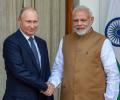
CAATSA was aimed at Moscow and not intended to damage the military capabilities of its 'allies and partners', US said.
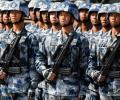
He called for delineation of the 3,488-km Line of Actual Control (LAC) which China has refused earlier.

His remarks without naming any country came against the backdrop of tension between India and Pakistan after New Delhi revoked Jammu and Kashmir's special status.

China and India on Wednesday held their upgraded strategic dialogue to shore up bilateral ties amid hectic parleys to resolve differences over Beijing's reluctance to support India's bid for Nuclear Suppliers Group membership as well as a United Nations ban on JeM chief Masood Azhar.
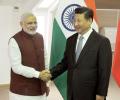
China on Thursday said its stand on blocking India against UN action on Pakistan was based on "facts" and in the spirit of "objectiveness and fairness".

If China's behaviour in the past on ticklish issues is any indication then China could eventually support India's NSG application, says Rup Narayan Das.
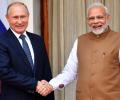
'Washington senses that the anchor sheet of India's strategic autonomy lies in its longstanding partnership with Russia, which remains firm and immutable despite the changes in world politics in the post-Cold War era,' notes Ambassador M K Bhadrakumar.<

The bilateral relations have maintained sound momentum of growth, thanks to the mutual visits of the leaders by the two countries, Chinese foreign ministry said.

Terrorism and Afghanistan were the focus points of Prime Minister Narendra Modi's talks with Uzbek President Islam Karimov on his first visit to Central Asia.

'Significantly, Foreign Secretary Gokhale was received at very high level in Beijing.' 'It only shows China's keenness to move forward and put the relationship on a 'win-win' footing,' says Ambassador M K Bhadrakumar.

The meeting between Prime Minister Nawaz Sharif and his Indian counterpart Narendra Modi drew mixed reactions in Pakistan, with most of the political parties accusing Sharif of failing to highlight Kashmir but the media was generally positive.

'Will Muhammad Habib Zahir -- who was part of the team that arrested Kulbhushan Jadhav and went missing in Nepal -- figure in a Jadhav-for-Zahir deal?' asks Aditi Phadnis.

The readouts by the Indian and Chinese sides on the meeting on Monday between External Affairs Minister Sushma Swaraj and her Chinese counterpart Wang Yi in Moscow bring out that divergences are crowding into the centrestage of their relationship, says Ambassador M K Bhadrakumar.

Outlining eight "pillars" for the future of India-China relations, President Pranab Mukherjee on Wednesday underlined the need for comprehensively resolving challenges including the boundary question through "political acumen" and "civilisational wisdom".

'Happily,' says Ambassador B S Prakash, 'BRICS displayed new-found energy and built something real, a bank. Between needless nihilism and as yet unjustified euphoria, there are many stations for the BRICS train and we can watch its progress with renewed interest.'
